

The statute of limitations sets the time period during which victims and their families must file certain types of lawsuits. For asbestos-related cases such as personal injury and wrongful death lawsuits, the average time limit is three years from the date of discovery. More than one state’s statute of limitations may apply to your case. The relatively short timeframe generally requires people to speak with an experienced mesothelioma attorney as soon as possible to begin preparing the appropriate court documents.
Understanding the mesothelioma statute of limitations by state early in a mesothelioma diagnosis helps ensure a lawsuit is filed within the appropriate timeframe. This gives attorneys more time to prepare a case and grants victims of asbestos exposure a greater opportunity to seek proper financial compensation for themselves or their families.
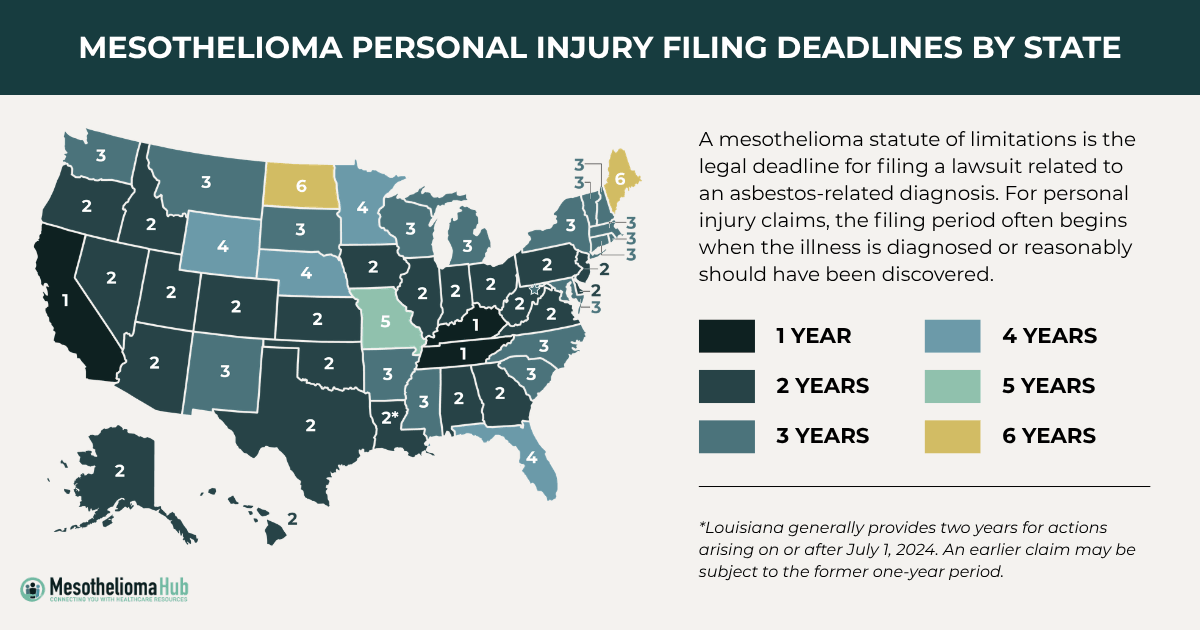
Personal injury statutes of limitations are set at the state level across the United States. The table below reflects general filing deadlines by state. Consult with an attorney for each state’s rev stat to confirm mesothelioma statute of limitations by state and how they may apply to your specific situation.
A mesothelioma statute of limitations sets a strict deadline for filing a lawsuit related to asbestos exposure, whether that be on the job or unknowingly. If you have been exposed to asbestos, you may have heard from commercials and radio that you could be eligible for compensation paid out by companies that failed to protect their employees or knowingly used products with asbestos. However, just because you were exposed while on the job or secondhand doesn’t mean you can file a claim whenever you want to. In fact, there is a legal deadline for filing a lawsuit, which is known as the statute of limitations. Missing this deadline can severely limit your ability to seek compensation. In this article, we will go further into each type and provide information and legal resources on how the mesothelioma statute of limitations might affect you.
Two main types of asbestos lawsuits affected by statutes of limitations are personal injury lawsuits and wrongful death cases. Living victims file personal injury lawsuits and are typically governed by the date of diagnosis of the asbestos-related illness. Wrongful death lawsuits are filed by family members after a loved one’s death from an asbestos-related illness and are usually governed by the date of death. The timeframe for these lawsuits varies by state, with the average being three years.
To best answer this question, first, you need to know the specifics of your exposure and health status. Consulting an experienced asbestos lawyer offers several advantages, especially in navigating the statute of limitations, which varies by state. For example, Illinois may have different limitations than Missouri. An experienced mesothelioma attorney can guide you through this legal process and make sure you meet all the requirements to file within the appropriate timeframe. Filing a mesothelioma claim involves gathering medical records, employment history, and other documentation to support your case. Many states follow the “discovery rule,” meaning the statute of limitations clock doesn’t begin until you are diagnosed and know or should have known the illness is linked to asbestos exposure. It’s important to note that the statute of limitations applies only when you take legal action following a mesothelioma diagnosis, and you should always consult with a mesothelioma attorney when filing an asbestos claim. An attorney can clarify how this rule applies to your situation.
Asbestos litigation is best left to the professionals, particularly when identifying the companies responsible for it. A skilled lawyer with experience in the courtroom and with handling hundreds of similar cases is what makes all the difference in compensation amounts. Many asbestos attorneys work on a contingency basis, meaning they only get paid if you win your case, eliminating upfront legal costs. Some lawyers may even travel to meet with you. Due to the relatively short statute of limitations for asbestos lawsuits, contacting a qualified mesothelioma lawyer as soon as possible is highly recommended. They can assess your case, explain your legal options, and ensure you meet all deadlines to pursue the compensation you may be entitled to.
Each state has its own legal statutes of limitations for personal injury and wrongful death cases. When dealing with mesothelioma cases, it’s possible to file in multiple states if exposure happens in multiple states. Again, an experienced lawyer can be extremely helpful in facilitating your lawsuit filing.
The list below provides rough time frames for both personal injury and wrongful death cases by state. You should consult an attorney for the most up-to-date information. An attorney will also be able to assist you in determining where to file. States that you’ve lived or worked in, and even states where the company responsible for your exposure was located, can all factor into where you should file. Those seeking California mesothelioma information would benefit from consulting with an attorney directly, as the state’s one-year filing window is among the shortest in the U.S., stressing the importance of timely discovery and filing for a mesothelioma case.
| Location (state) | Personal injury (years) | Wrongful death (years) |
|---|---|---|
| Alabama | 2 | 2 |
| Alaska | 2 | 2 |
| Arizona | 2 | 2 |
| Arkansas | 3 | 3 |
| California | 1 | 1 |
| Colorado | 2 | 2 |
| Connecticut | 3 | 3 |
| Delaware | 2 | 2 |
| Florida | 4 | 2 |
| Georgia | 2 | 2 |
| Hawaii | 2 | 2 |
| Idaho | 2 | 2 |
| Illinois | 2 | 2 |
| Indiana | 2 | 2 |
| Iowa | 2 | 2 |
| Kansas | 2 | 2 |
| Kentucky | 1 | 1 |
| Louisiana | 2 | 1 |
| Maine | 6 | 2 |
| Maryland | 3 | 3 |
| Massachusetts | 3 | 3 |
| Michigan | 3 | 3 |
| Minnesota | 4 | 3 |
| Mississippi | 3 | 3 |
| Missouri | 5 | 3 |
| Montana | 3 | 3 |
| Nebraska | 4 | 2 |
| Nevada | 2 | 2 |
| New Hampshire | 3 | 3 |
| New Jersey | 2 | 2 |
| New Mexico | 3 | 3 |
| New York | 3 | 2 |
| North Carolina | 3 | 2 |
| North Dakota | 6 | 2 |
| Ohio | 2 | 2 |
| Oklahoma | 2 | 2 |
| Oregon | 2 | 3 |
| Pennsylvania | 2 | 2 |
| Rhode Island | 3 | 3 |
| South Carolina | 3 | 3 |
| South Dakota | 3 | 3 |
| Tennessee | 1 | 1 |
| Texas | 2 | 2 |
| Utah | 2 | 2 |
| Vermont | 3 | 2 |
| Virginia | 2 | 2 |
| Washington | 3 | 3 |
| Washington D.C. | 3 | 1 |
| West Virginia | 2 | 2 |
| Wisconsin | 3 | 3 |
| Wyoming | 4 | 2 |
*Louisiana generally provides two years for actions arising on or after July 1, 2024. An earlier claim may be subject to the former one-year period.
Inhaling asbestos fibers can become lodged in the lungs, often leading to mesothelioma decades later. This long latency period presents a unique challenge when pursuing legal compensation through a personal injury lawsuit. Fortunately, the legal system acknowledges this difficulty through statutes of limitations, which vary by state. Each state has its own specific statute of limitations for filing a mesothelioma-related lawsuit, typically starting from the date of injury. However, the “injury” might not be apparent in asbestos cases for many years.
As we said earlier, many states have adopted the “discovery rule”, which delays the start of the statute of limitations clock until the date of diagnosis or when the plaintiff knew or should have known their illness was linked to asbestos exposure. This provides much-needed time for those exposed to asbestos who contracted a disease or related illness to gather evidence and seek legal counsel.
While no amount of financial compensation can replace someone who passed wrongfully, a wrongful death lawsuit can provide some financial stability for your family as long as it’s filed within the statute of limitations. Identifying the responsible parties in wrongful death lawsuits can be challenging due to uncertain exposure histories. An experienced asbestos lawyer can analyze employment records, military service, and environmental factors to pinpoint intricacies and liable parties.
With expertise in complex legal structures, these lawyers handle inquiries, manage tasks, and calculate fair compensation for matters involving multiple corporations or trust funds. A qualified mesothelioma lawyer will provide both legal expertise and compassionate support, ensuring you secure the justice and financial security your family deserves.
Since it was discovered that prolonged exposure to the asbestos mineral causes cancer and other diseases, patients and their family members began bringing lawsuits against asbestos companies. As a result, many of these companies filed for Chapter 11 bankruptcy. In these cases, federal courts required the companies to establish trust funds in order to provide compensation to victims of mesothelioma and other asbestos-related diseases. These trusts currently amount to more than $37 million.
Because asbestos trust funds are established under federal bankruptcy law, the state laws governing statutes of limitations for lawsuits against still-existing asbestos companies do not apply to claims filed against trust funds. Instead, the timeframe for filing a trust claim is determined on a case-by-case basis and depends on some factors. Because of this, people with mesothelioma and their families are eligible to file claims against multiple companies; often, they choose to pursue lawsuits against any still-existing companies first, as those are the most time-sensitive cases. However, filing asbestos-related lawsuits and pursuing an asbestos trust fund are not mutually exclusive. In cases involving exposure from multiple companies, individuals may pursue lawsuits against operating companies and claims against the trust funds of bankrupt companies at the same time.
A statute of limitations combines a “statute,” or written law, and a “limitation,” the time restriction it imposes. Together, they set a deadline for filing a lawsuit after an event occurs, and it exists to preserve evidence and ensure a fair, timely trial. Each state sets its deadlines through its rev stat, the official, organized collection of the state’s laws. Because each state sets its own limitations deadline, deadlines can vary from state to state.
Statutes of limitations are related to civil procedure rather than criminal law. Civil procedure governs private lawsuits, such as cases involving asbestos injury claims, in which one party sues another for compensation. In contrast, criminal law has its own statutes of limitations that set the timeframe for when the government can prosecute an individual for a crime.
Once the period ends, the injured party loses the right to file or pursue a lawsuit in court. If the statute of limitations expires for an asbestos injury claim, the claim doesn’t disappear, nor does the injury, but the ability to file a lawsuit against responsible parties in that state does. This emphasizes the importance of filing a claim as soon as possible to avoid missing critical deadlines. Before filing a claim, understand the statutes of limitations in your state or the state where you plan to file.
The discovery rule is an exception to the statute of limitations that changes the timeline for filing a case. When an injury is not immediately obvious, this rule pauses the statute of limitations until the individual becomes aware, or reasonably should have become aware, of their injury and that someone else’s negligence may have caused it.
For mesothelioma patients, the discovery rule allows the statute of limitations to start on the date of a formal mesothelioma diagnosis from a doctor rather than the date of asbestos exposure. Because mesothelioma is a latent disease, it can often take decades to present symptoms and receive a diagnosis. This rule allows patients and their families to pursue personal injury or wrongful death claims, regardless of how long it has been since the exposure event. Without it, the statute of limitations would expire before a patient ever knew they were sick.
While the discovery rule gives mesothelioma patients more time to file a mesothelioma claim, it does not override state-specific mesothelioma statutes of limitations. It only affects when the clock starts. Because of this, asbestos victims and surviving family members should be mindful of the diagnosis date and ensure all necessary documentation is ready to present to an attorney and file according to each state’s deadline.
If you miss the statute of limitations in your state or the state where you intend to file a personal injury or wrongful death claim, you will lose your right to pursue that claim in that state. This is why it’s important to act quickly to protect your family’s legal rights, filing upon receiving your mesothelioma diagnosis to ensure you meet the appropriate deadline.
However, even if you miss your filing deadline, you may still be able to pursue compensation. A mesothelioma settlement or mesothelioma compensation may still be possible through an asbestos trust fund claim. Asbestos trust funds follow separate federal timelines, not state timelines. Because they are established under federal bankruptcy law, they have their own filing deadlines and rules, which differ from trust to trust. A mesothelioma lawyer can assess where your case stands and whether you’re eligible to file a claim, whether it’s a personal injury or wrongful death claim or a claim against an asbestos trust fund.
The statutes of limitations for filing claims vary significantly by state, with some states offering shorter timeframes than others. For example, when referencing the table above, you’ll notice that California has one of the shortest deadlines in the United States, allowing mesothelioma patients just one year from the date of diagnosis to file a claim. In contrast, Missouri offers one of the longer filing periods, giving patients five years to file for personal injury claims. While states like California and Missouri are outliers, most states, including Illinois, generally have a two-year filing timeframe. These deadline differences highlight the need for an attorney well-versed in state-specific asbestos exposure and each state’s limitations to ensure you submit your claim promptly.
Regardless of your current residence, any diagnosed asbestos-related case, including pleural mesothelioma (the most common type of mesothelioma), should be assessed based on the state where the exposure occurred, not just where the individual currently lives.
No, the statute of limitations does not typically differ for lung cancer caused by asbestos. Lung cancer and other forms of asbestos disease generally follow the same state-level personal injury deadlines as mesothelioma.
A wrongful death statute is a law that sets a time limit for filing a claim following a person’s death. Unlike personal injury deadlines, which start from the date of the accident or injury, or even from the date of diagnosis, the timeframe for a wrongful death claim begins on the date of the individual’s death.
Yes, you may still be eligible to take legal action, even if you are unsure of where you were exposed to asbestos. If you have been diagnosed with mesothelioma, it’s essential that you act quickly to seek legal representation from an experienced mesothelioma attorney, who can help investigate your exposure history, even without a known source, through the asbestos litigation process.
Most firms, including a law office experienced in asbestos cases, offer free case evaluations and do not charge anything to review your mesothelioma case. They review your medical records, exposure history, and the statute of limitations to determine whether you have a legal right to file a lawsuit. If you have a valid claim and the firm decides to take your case, they then operate on a contingency fee basis, meaning that you will not pay any legal fees upfront. You only pay if they successfully secure a settlement for your case.
Yes, you can still file a claim for your asbestos disease years after your exposure. Because of the discovery rule, which shifts the statute of limitations to start from the date of diagnosis rather than the date of exposure, you can still file as long as you do so within your state’s mesothelioma statute of limitations.
Learn more about Mesothelioma Legal Help
It is highly encouraged that you work with a specialized asbestos lawyer when taking legal action in these types of cases. Your lawyer will ensure you and your family are protected, and your chances of successfully pursuing a lawsuit and/or trust fund claim are significantly higher. If you or someone you know has been diagnosed with mesothelioma, you may be eligible for compensation. Because of the statute of limitations, it’s important to speak with an asbestos lawyer as soon as possible. Fill out a free case evaluation to connect with a leading litigation lawyer. You may have a valid asbestos claim, and you have legal rights worth understanding before you decide what to do next.
Our team of authors collaborates with the advocate team, focusing on writing about asbestos exposure and mesothelioma to spread awareness. They are dedicated to supporting families within the mesothelioma community.

Sara M. Salger is a dedicated advocate for individuals affected by asbestos exposure and serves as a Managing Partner at the Gori Law Firm and a legal content reviewer at Mesothelioma Hub. She graduated cum laude with her undergraduate degree from Southern Illinois University Edwardsville and received her J.D. from Saint Louis University School of Law, where she also obtained an International Law Certificate and specialized in litigation. During law school, Sara broadened her legal perspective by studying abroad at Università Cà Foscari di Venezia in Venice, Italy, and University College Cork in Cork, Ireland. Throughout her legal career, Sara has focused on representing victims of asbestos exposure who have been diagnosed with mesothelioma.
Sara also represents people with lung cancer resulting from negligence and handles complex benzene litigation and personal injury claims. Since joining The Gori Law Firm at its inception and becoming a Partner in 2016, she has been licensed to practice law in Illinois and Missouri. Sara’s dedication to her clients and field has earned her numerous accolades, including being named one of the Top 10 Asbestos/Mesothelioma Trial Lawyers by The National Trial Lawyers in 2021.
The American Law Institute.. (1977). Products Liability. Retrieved on July 17, 2019, from https://biotech.law.lsu.edu/cases/products/402a-b.htm
Carroll, Stephen J; et al. (2005). Asbestos Litigation. Retrieved on July 17, 2019, from https://rand.org/content/dam/rand/pubs/monographs/2005/RAND_MG162.sum.pdf
Creighton Law Review. (1992). Asbestos Litigation and Statutes of Repose: The Application of the Discovery Rule in the Eighth Circuit Allows Plaintiffs to Breathe Easier. Retrieved on July 25, 2018, from https://dspace.creighton.edu:8080/xmlui/bitstream/handle/10504/39872/43_24CreightonLRev965%281990-1991%29.pdf?sequence=1&isAllowed=y
Dixon, Lloyd; McGovern, Geoffrey; Coombe, Amy. (2010). Asbestos Bankruptcy Trusts. Retrieved on July 17, 2019, from https://rand.org/content/dam/rand/pubs/technical_reports/2010/RAND_TR872.pdf
United States Environmental Protection Agency. (n.d.). Asbestos Laws and Regulations. Retrieved on July 29, 2019, from <a href=”https://epa.gov/asbestos/asbestos-laws-and-regulations” target=”_blank” rel=”nofollow noopener”>https://epa.gov/asbestos/asbestos-laws-and-regulations</a>