

There are four stages of pleural mesothelioma, which develops in the lining of the lungs and chest. Stage 1 is the earliest: the cancer is on one side of the chest and has not spread to nearby lymph nodes or distant parts of the body. Doctors use the TNM system to determine its stage. Symptoms may be mild or easy to mistake for another condition, but an early diagnosis may offer more treatment options. Other types of mesothelioma do not use the same formal staging system.
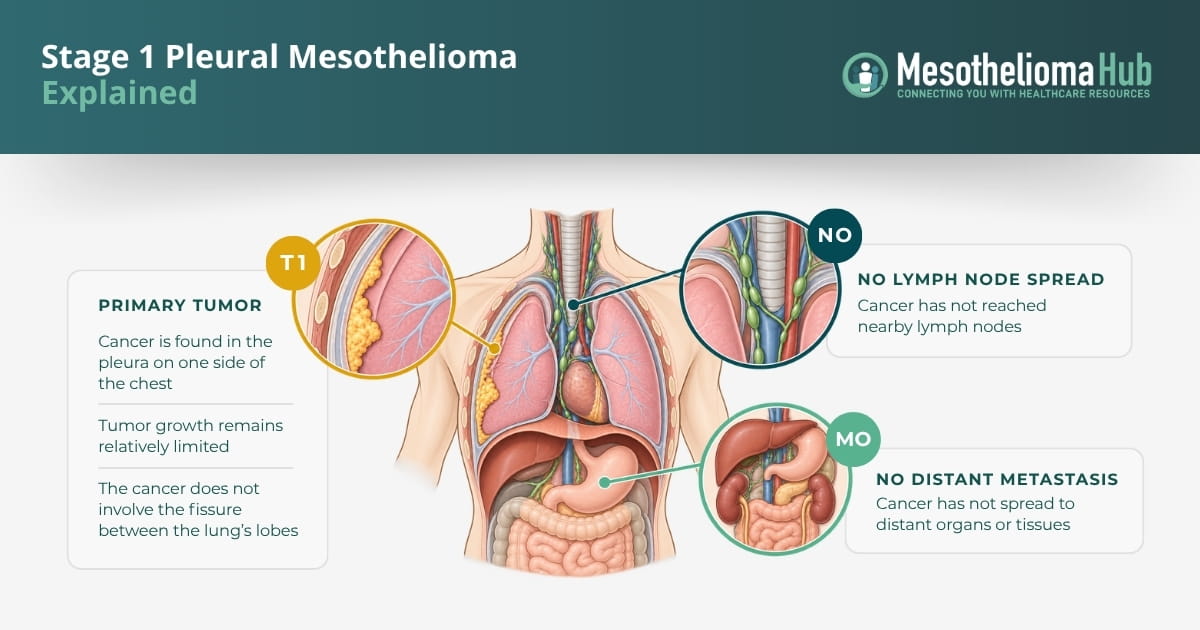
Stage 1 pleural mesothelioma is the least advanced stage and generally has a better prognosis than later stages. The cancer is limited to the pleura on one side of the chest. It has not spread to nearby lymph nodes or distant parts of the body.
Doctors may consider surgery, chemotherapy, immunotherapy, or radiation therapy depending on whether the cancer can be removed and the patient’s overall health. Some treatments may be used together, but there is no single treatment plan for everyone with stage 1 mesothelioma. Even after surgery removes all visible cancer, microscopic cells may remain.
Stage 1 Mesothelioma at a Glance
The meaning of an early mesothelioma diagnosis differs depending on where the cancer starts. Only pleural mesothelioma has a formal stage 1 classification. Doctors still assess the extent of other types without applying pleural staging rules to them.
Doctors stage pleural mesothelioma using the American Joint Committee on Cancer (AJCC) TNM system. The letters describe the extent of the primary tumor (T), spread to nearby lymph nodes (N), and spread to distant parts of the body, called metastasis (M). Older systems, including Butchart and Brigham, may appear in older articles, but the AJCC TNM system is the reference for the stage descriptions on this page.
Under the current AJCC system, stage 1 pleural mesothelioma is T1, N0, M0. The cancer is in the pleura on one side of the chest, with no nearby lymph node involvement or distant spread. The current system no longer divides this stage into the older stage 1A and 1B groups. Your doctor can explain the findings behind your individual stage.
Peritoneal mesothelioma develops in the lining of the abdomen. It does not have the same established staging system as pleural mesothelioma. Doctors assess the location and extent of the cancer to plan treatment. One tool they may use is the Peritoneal Cancer Index (PCI), which measures how much disease is present throughout the abdomen. A lower score generally indicates less extensive disease; it does not, by itself, establish a formal “stage 1 peritoneal mesothelioma” diagnosis or determine whether surgery is appropriate.
An earlier research study proposed a peritoneal staging system that grouped some patients with PCI scores of 1–10 as stage I when they also had no identified lymph node or distant spread. That proposed classification should not be presented as a universal PCI cutoff.
Pericardial mesothelioma develops in the lining around the heart. This type is rare and has no established formal staging system. Doctors evaluate where the cancer is and whether it has spread when considering treatment.
Testicular mesothelioma starts in the lining around a testicle. It also has no established formal mesothelioma staging system. Doctors assess the tumor and any spread to help plan care.
People with early pleural mesothelioma may have subtle symptoms that can be mistaken for other conditions, such as a respiratory illness. Possible symptoms include:
These symptoms are not specific to stage 1. Having symptoms does not mean the cancer has spread, and symptoms alone cannot establish its stage. If you have persistent symptoms, tell your health care provider about any known or suspected asbestos exposure. Learn more about mesothelioma symptoms.
Diagnosing mesothelioma and determining its stage are related but different steps. Doctors may use imaging, such as a chest X-ray or CT scan, to look for abnormalities and assess the extent of disease. A biopsy allows a pathologist to examine cells or tissue to help confirm the diagnosis and identify the cancer’s cell type.
Imaging, examinations, and biopsy results help doctors assign a clinical stage and plan treatment. If a patient has surgery, findings from the operation can help establish a pathological stage, which may differ from the initial clinical stage. Ask your care team which tests were used to determine your stage.
Stage 1 pleural mesothelioma generally has a better outlook than more advanced disease, but no survival statistic can predict an individual’s life expectancy. Prognosis also depends on cell type, whether visible cancer can be removed, overall health, and response to treatment.
For context, the American Cancer Society reports a 23% five-year relative survival rate for localized pleural mesothelioma, based on people diagnosed in the United States from 2015 through 2021. “Localized” is a category used in cancer statistics and is not identical to AJCC stage 1. The figure represents a group of patients with varied circumstances; it is not a prediction for someone newly diagnosed with stage 1 mesothelioma.
People with stage 1 pleural mesothelioma may have several treatment options, although they must be healthy enough for any procedure or medicine their doctors recommend. A key question is whether the cancer is resectable, meaning a surgeon expects to be able to remove all visible tumors. Stage 1 makes surgery more likely to be an option, but does not guarantee it. Cell type, tumor location, and lung and heart health also matter.
For selected patients, surgery may include pleurectomy/decortication, which removes affected pleural tissue while preserving the lung. An extrapleural pneumonectomy, a more extensive operation that removes a lung and nearby tissue, may be considered in some cases but carries a greater risk of complications. The goal of surgery is to remove all visible cancer; microscopic cells may remain.
Doctors may also consider chemotherapy, immunotherapy, or radiation therapy before or after surgery, or use systemic treatment without surgery. A clinical trial may offer another option. Supportive care can help relieve symptoms or treatment side effects alongside other care. Treatment should be tailored to the individual rather than described as a standard combination of all four therapies.
Treatment differs for other types of mesothelioma. For some patients with peritoneal disease, specialists may consider cytoreductive surgery and heated intraperitoneal chemotherapy (HIPEC). People with pericardial or testicular mesothelioma need an individualized assessment; a pleural stage 1 plan does not automatically apply.
A second opinion may help confirm the diagnosis and clarify treatment options. Your pathology report, slides, and scans can be shared with the second specialist.
Need help understanding your options? Connect with a patient advocate to learn about mesothelioma specialists and treatment resources.
Madeline May is a content specialist with more than five years of writing experience. She creates and reviews accurate, helpful content for patients and families affected by lung cancer and mesothelioma, with a focus on making complex topics clear, accessible, and easy to understand. Madeline holds a Bachelor of Business Administration with a specialization in marketing from Southern Illinois University Edwardsville. Her background in marketing and content development helps her create informative online resources that address readers’ questions and needs.
American Cancer Society. (2018). About malignant mesothelioma. https://cancer.org/content/dam/CRC/PDF/Public/8733.00.pdf
American Cancer Society. (2026, February 3). Mesothelioma. https://www.cancer.org/cancer/types/malignant-mesothelioma.html
American Cancer Society. (2026, February 3). Stages of mesothelioma. https://www.cancer.org/cancer/types/malignant-mesothelioma/detection-diagnosis-staging/staging.html
American Cancer Society. (2026, February 3). Survival rates for pleural mesothelioma. https://www.cancer.org/cancer/types/malignant-mesothelioma/detection-diagnosis-staging/survival-statistics.html
American Cancer Society. (2026, February 3). Treating mesothelioma. https://www.cancer.org/cancer/types/malignant-mesothelioma/treating.html
American Cancer Society. (2026, February 3). Signs and symptoms of mesothelioma. https://www.cancer.org/cancer/types/malignant-mesothelioma/detection-diagnosis-staging/signs-symptoms.html
Bonomi, M., et al. (2017). Clinical staging of malignant mesothelioma: Current perspectives. https://ncbi.nlm.nih.gov/pmc/articles/PMC5571821/
Faig, J. (2015). Changing pattern in malignant mesothelioma survival. https://sciencedirect.com/science/article/pii/S1936523314001363
Mayo Clinic. (2019). Mesothelioma. https://mayoclinic.org/diseases-conditions/mesothelioma/symptoms-causes/syc-20375022
National Cancer Institute. (2019). Malignant mesothelioma symptoms, tests, prognosis, and stages (PDQ®)—Patient version. https://cancer.gov/types/mesothelioma/patient/about-mesothelioma-pdq#section/_26
National Cancer Institute. (2025, May 16). Mesothelioma diagnosis & prognosis. https://www.cancer.gov/types/mesothelioma/diagnosis-prognosis