

A Stage 4 mesothelioma diagnosis can be incredibly difficult to navigate. It’s common to have questions about what this stage means, Stage 4 mesothelioma life expectancy, and treatment options. Although Stage 4 is advanced, there are still ways to manage symptoms and receive care while maintaining comfort and quality of life.
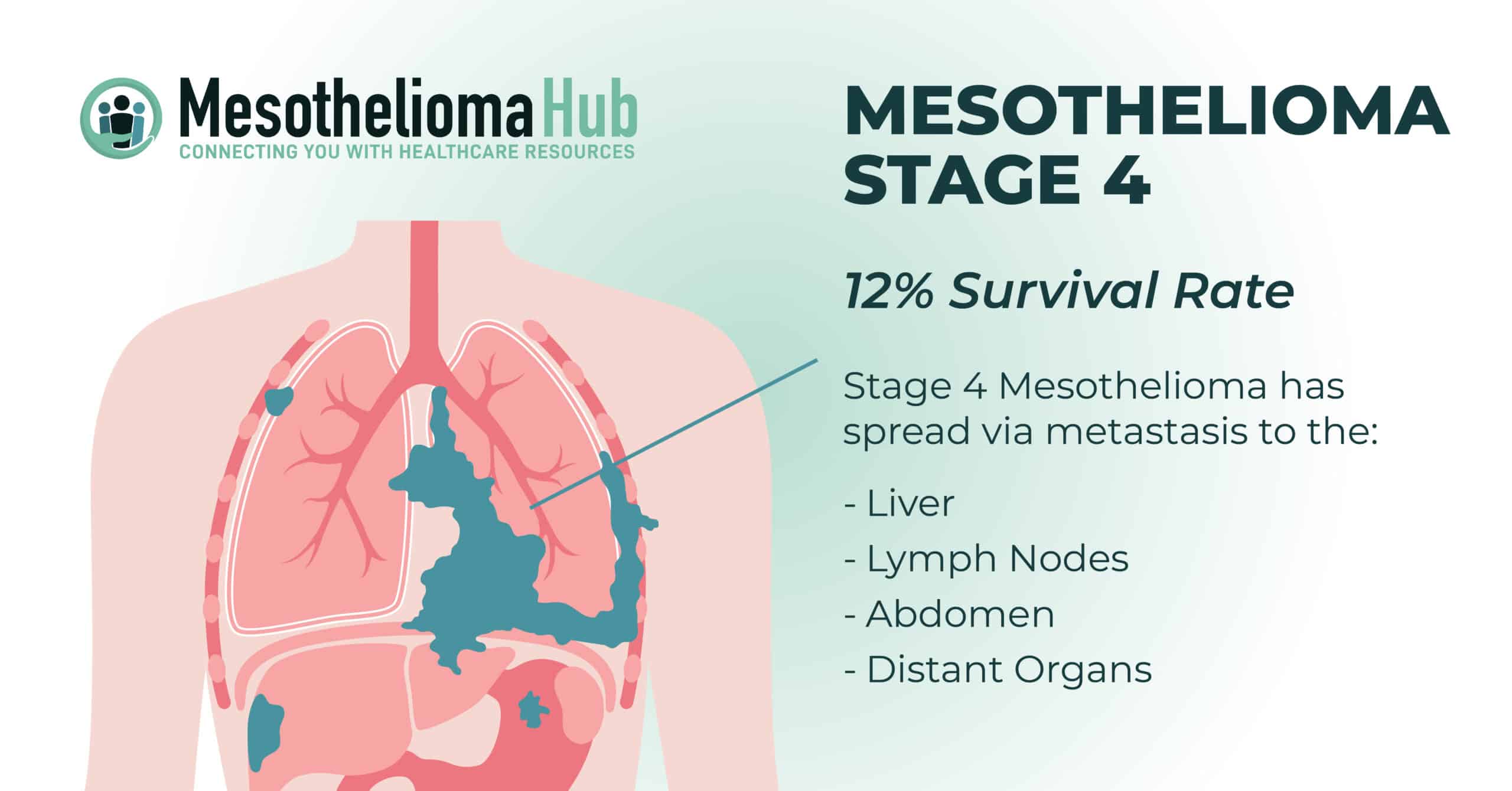
Stage 4 mesothelioma is the final and most advanced stage of this cancer. At this stage, the disease has spread (metastasized) beyond where it first developed to other organs or lymph nodes. Metastasis occurs when cancer cells travel through the bloodstream or lymphatic system and form tumors in other parts of the body.
For many people, receiving this information can feel frightening or hard to process. This stage simply helps doctors understand how the disease has progressed, including whether cancer cells have reached nearby organs or lymph nodes, so they can recommend the most appropriate care and support.
Although no longer treated with surgery, it does not mean that care or treatment comes to an end. Many patients continue stage 4 mesothelioma treatment to help slow disease progression and maintain comfort and quality of life.
Doctors use the TNM staging system to describe how advanced mesothelioma is. TNM stands for tumor (T), lymph nodes (N), and metastasis (M). This system helps doctors evaluate the size and extent of the main tumor, whether the cancer has spread to nearby lymph nodes, and whether it has reached distant organs.
While Stage 4 mesothelioma is sometimes referred to as end-stage mesothelioma, or one of the mesothelioma final stages, outcomes can vary widely. Life expectancy and prognosis are based on averages from large patient groups and do not predict how any one individual will respond to treatment. Factors such as overall health, mesothelioma type, response to therapy, and access to specialized care all play an important role and directly inform discussions about mesothelioma Stage 4 life expectancy.
A patient in Stage 4 mesothelioma may experience aggressive, painful symptoms. You will likely want to seek information about what is causing your pain. A lot of mesothelioma diagnoses come in Stage 3 or 4 because of the painful onset of symptoms.
Symptoms will vary based on where the cancer is located. Treatment options may be available to relieve symptoms and improve the patient’s quality of life. Oftentimes, treatment options are minimal in stage 4, and patients turn to palliative care to manage their symptoms. Many of the symptoms in stage 4 are similar to those in other stages but are typically more persistent.
Possible symptoms may include:
Managing symptoms is a central part of care for mesothelioma in the final stages. While the disease itself may be advanced, many symptoms can be treated or relieved, helping patients feel more comfortable and better able to manage daily life.
Common symptom-management options include:
If you or a loved one is experiencing symptoms, palliative care can help at any stage of mesothelioma, not just at the end of life. Palliative care supports comfort, symptom relief, and emotional well-being, and can be integrated alongside active treatment.
Stage 4 mesothelioma life expectancy varies widely and depends on several factors, including the type of mesothelioma, cell type, overall health, age, response to treatment, and access to specialized care.
Based on large patient studies, median survival estimates for Stage 4 mesothelioma are:
Testicular and pericardial mesothelioma are not included here because they are exceptionally rare. As a result, there is limited clinical data available to calculate meaningful average survival timelines by stage. In these cases, prognosis is highly individualized and depends on factors such as overall health, treatment approach, and specialist care.
Recent advances have improved outcomes for some patients with Stage 4 mesothelioma. FDA-approved immunotherapy combinations, including nivolumab (Opdivo) and ipilimumab (Yervoy), have extended survival beyond 18 months for certain stage 4 patients. Participation in clinical trials has also allowed some individuals to exceed typical survival expectations by several years.
Survival statistics are based on population data and should be viewed as general guidance rather than certainty, according to the National Cancer Institute.
Stage 4 pleural mesothelioma is the most common form of the disease, making up about 75–80% of cases. It affects the lining of the lungs (pleura) and, at this stage, has spread beyond the original tumor to nearby lymph nodes or distant organs.
With standard chemotherapy, most often pemetrexed (Alimta) combined with cisplatin, median survival is around 12 months. Without treatment, survival is typically closer to 6–8 months.
Newer treatments have improved outcomes for some patients. FDA-approved immunotherapy combinations, such as nivolumab (Opdivo) and ipilimumab (Yervoy), have extended median survival to approximately 18 months in certain cases. In carefully selected patients with good overall health, a multimodal treatment regimen combining chemotherapy, radiation, and, sometimes, surgery may extend survival to 23 months or longer, although surgery is rarely recommended at this stage.
Survival can vary based on several factors, including cell type, overall health, and how far the disease has spread. Patients with the epithelioid cell type generally have a more favorable outlook than those with sarcomatoid or biphasic disease. Ongoing clinical trials continue to explore new treatments aimed at improving outcomes for advanced pleural mesothelioma.
Stage 4 peritoneal mesothelioma accounts for about 15–20% of cases and often has a more favorable outlook than pleural mesothelioma, even at advanced stages.
With aggressive treatment, most commonly cytoreductive surgery (CRS) combined with heated intraperitoneal chemotherapy (HIPEC), median survival can reach around 26 months. Some stage 4 patients may still be eligible for CRS and HIPEC if the disease remains largely confined to the abdomen.
Doctors use the Peritoneal Cancer Index (PCI) to assess how far the disease has spread, with scores of 31-39 typically indicating stage 4. Studies show that select stage 4 patients who successfully undergo HIPEC can have 5-year survival rates exceeding 40%.
Without treatment, survival for those with peritoneal mesothelioma is often closer to 6 months. Better outcomes are associated with disease staying within the abdominal cavity for longer, the targeted delivery of heated chemotherapy, and overall health factors such as age and fitness.
Stage 4 pericardial mesothelioma is extremely rare, accounting for just 1–2% of all mesothelioma cases. Because so few cases are diagnosed, available survival data is limited.
On average, survival is around 6 months, regardless of treatment. Pericardial mesothelioma affects the lining around the heart (pericardium) and is often diagnosed at an advanced stage, as symptoms can resemble other heart conditions. In some instances, the disease is not identified until after death.
By stage 4, the cancer often spreads within the chest and can interfere with normal heart function. Treatment options are limited due to the tumor’s location and late diagnosis, so care typically focuses on comfort and symptom relief, such as easing chest pain, reducing fluid buildup, and improving breathing, while supporting quality of life.
Outcomes vary based on how much the heart is affected and the patient’s overall health at diagnosis.
Stage 4 testicular mesothelioma is the rarest form, accounting for less than 1% of cases. There is no formal staging system, and prognosis is assessed on a case-by-case basis.
It often presents earlier due to visible swelling or lumps. Stage 4 indicates spread to lymph nodes or distant organs. Treatment typically involves orchiectomy followed by chemotherapy. Some patients survive for several years, partly because they are of a younger age at diagnosis.
Age can influence stage 4 mesothelioma survival, but it’s only one part of the picture. Younger patients often have better outcomes because they’re more likely to tolerate aggressive treatment.
On average, patients under 50 have a median survival of about 15–18 months, while those over 75 tend to have a median survival closer to 8–10 months. These figures reflect overall trends, not individual outcomes.
Overall health and fitness often matter more than age alone. For example, a healthy 70-year-old may tolerate treatment better than a younger person with multiple health conditions.
Older patients may face more limits on surgery or chemotherapy due to side effects or other medical issues. Younger patients are more likely to qualify for clinical trials and multimodal treatment. Ultimately, individual health remains the most important factor in determining prognosis and care options.
A stage 4 mesothelioma prognosis reflects the overall outlook of the disease, not a fixed life expectancy. While statistics offer general guidance, prognosis varies widely based on how the cancer behaves and responds to treatment in each person.
At this stage, the cancer has spread beyond its original site, which limits curative options. Still, prognosis is not the same for everyone. Some patients respond well to treatment and live longer than expected, especially when cared for by specialists experienced in mesothelioma.
Access to specialized centers can make a meaningful difference. These teams often offer advanced treatments, including immunotherapy and clinical trials, and ongoing advances continue to improve outlooks for some stage 4 patients.
Several medical and personal factors influence mesothelioma stage 4 prognosis. Understanding these factors can help explain why outcomes vary so widely from one person to another.
Treatment for stage 4 mesothelioma focuses on slowing the disease, easing symptoms, and supporting quality of life, as the cancer has spread beyond its original location. While treatment is usually not curative, many options can still help patients feel better and live longer.
Most patients receive systemic therapy, which treats cancer throughout the body. Chemotherapy has long been a standard option and may help shrink tumors, slow growth, and relieve symptoms, even though it is not a cure.
Immunotherapy is now an important option for some patients. These treatments help the immune system target cancer cells and, in certain cases, have been shown to extend survival. Immunotherapy may be used alone or in combination with chemotherapy.
Radiation therapy is typically used to manage symptoms rather than eliminate cancer. It can help reduce pain, ease pressure on organs, and improve breathing or swallowing when tumors cause discomfort.
Palliative care is a key part of stage 4 treatment and can be provided alongside active therapies. It focuses on symptom relief, emotional support, and overall well-being, and early use is linked to better quality of life.
Clinical trials may offer access to newer treatments, including emerging immunotherapies or drug combinations. Treatment decisions are made collaboratively, based on medical needs, overall health, and personal goals.
Living with Stage 4 mesothelioma may affect many areas of life, including physical health, emotional well-being, relationships, and daily routines. As symptoms change over time, patients may need increasing levels of support, both medically and practically.
Many people find it helpful to work with a coordinated care team that includes oncologists, palliative care specialists, nurses, social workers, and mental health professionals. This team-based approach can help address pain, breathing issues, fatigue, and emotional stress more effectively.
Support services can also help with practical concerns, such as transportation to appointments, managing medications, and navigating insurance or disability benefits. Patient advocacy organizations and community resources may provide additional guidance and connection.
A stage 4 diagnosis can make it difficult to absorb medical information, especially during early appointments. Preparing questions in advance can help make sure your concerns are addressed and that you understand your care plan.
In addition to asking about treatment options, many patients find it helpful to ask:
Bringing a trusted family member or friend to appointments or requesting written summaries can make these conversations easier to revisit later.
Coping with a stage 4 diagnosis is not purely a medical challenge; it is an emotional one. Feelings of fear, sadness, anger, and uncertainty are common, and these emotions may change over time.
Professional support can make a meaningful difference. Counselors, psychologists, or psychiatrists experienced in working with cancer patients can help manage anxiety or depression. Support groups, whether in person or online, allow patients to connect with others who understand what they are going through.
Caregivers also need support. Family members may experience stress, burnout, or emotional exhaustion, and counseling or caregiver-specific resources can help them cope while continuing to provide care.
At stage 4, maintaining quality of life is often the primary goal of care. While some aspects of the disease are beyond control, many others can be actively managed.
Small adjustments can make a meaningful difference. Pacing daily activities and accepting help when needed can help conserve energy. Working with a cancer nutritionist may improve strength and appetite, while gentle physical activity, such as short walks or stretching, can reduce fatigue and maintain mobility.
Many patients also explore complementary therapies such as acupuncture, massage, meditation, or music therapy to help manage stress and discomfort. These approaches can be used alongside medical treatment.
Importantly, quality of life also includes emotional and personal fulfillment. Spending time with loved ones, pursuing meaningful projects, or creating lasting memories can be an important part of living well with stage 4 mesothelioma.
For some people with mesothelioma, compensation can offer practical support and peace of mind. Financial recovery may help with treatment costs and daily expenses, while also providing a sense of accountability for past asbestos exposure. If you’d like to explore your options, our free guide or case evaluation can help you understand what support may be available.
Our team of authors collaborates with the advocate team, focusing on writing about asbestos exposure and mesothelioma to spread awareness. They are dedicated to supporting families within the mesothelioma community.
American Society of Clinical Oncology. (n.d.). Mesothelioma. Cancer.Net. https://www.cancer.org/cancer/types/malignant-mesothelioma.html
National Cancer Institute. (n.d.). Malignant mesothelioma treatment (PDQ®)–health professional version. U.S. Department of Health and Human Services. https://www.cancer.gov/types/mesothelioma/hp/mesothelioma-treatment-pdq
Sugarbaker, P. H. (2023). Cytoreductive surgery and HIPEC for peritoneal mesothelioma. Journal of Gastrointestinal Oncology, 14(5), 2372–2383. https://www.ncbi.nlm.nih.gov/pmc/articles/PMC10571654/
National Cancer Institute. (n.d.). SEER cancer statistics review. U.S. Department of Health and Human Services. https://seer.cancer.gov/statistics/
Taioli, E., Wolf, A. S., Camacho-Rivera, M., & Flores, R. M. (2022). Incidence, treatment, and survival of malignant pleural mesothelioma. Thorax, 77(12), 1260–1266. https://thorax.bmj.com/content/77/12/1260
U.S. National Library of Medicine. (n.d.). Mesothelioma. MedlinePlus. https://medlineplus.gov/mesothelioma.html