

Wisconsin ranks 16th out of 50 states for deaths related to asbestos exposure, with approximately 330 people dying from asbestos-related diseases each year. For Wisconsin residents diagnosed with mesothelioma or another asbestos-related disease, understanding your legal options early can be important, as the state’s statute of limitations for a mesothelioma claim is generally three years from diagnosis.
This page explores Wisconsin’s history of asbestos exposure, including high-risk job sites and industrial areas in Milwaukee County, Waukesha County, and Wisconsin Rapids. It also explains how a Wisconsin mesothelioma attorney or Wisconsin mesothelioma lawyer may help individuals and families pursue compensation connected to asbestos exposure.
Many industries throughout Wisconsin have historically used asbestos in construction, insulation, demolition, manufacturing, and other industrial applications. Wisconsin ranks 16th in the nation for deaths related to asbestos exposure. Between 1999 and 2013, Milwaukee, Waukesha, and Racine counties recorded the highest numbers of deaths linked to mesothelioma, lung cancer, and asbestosis. Mesothelioma is an asbestos-related cancer, while asbestosis develops when asbestos fibers cause long-term scarring in the lungs.
Asbestos is made up of six naturally occurring minerals that form in bundles of microscopic fibers. Before it was widely recognized as a carcinogenic, or cancer-causing, material, asbestos was commonly used in building and construction products because it was affordable, durable, and highly resistant to heat and fire.
Wisconsin’s asbestos exposure history is rooted in the state’s industrial economy. Foundries, paper mills, power plants, shipyards along Lake Michigan, and manufacturing facilities throughout Milwaukee County and Waukesha County relied heavily on asbestos products for insulation, fireproofing, and industrial equipment components well into the 1980s.
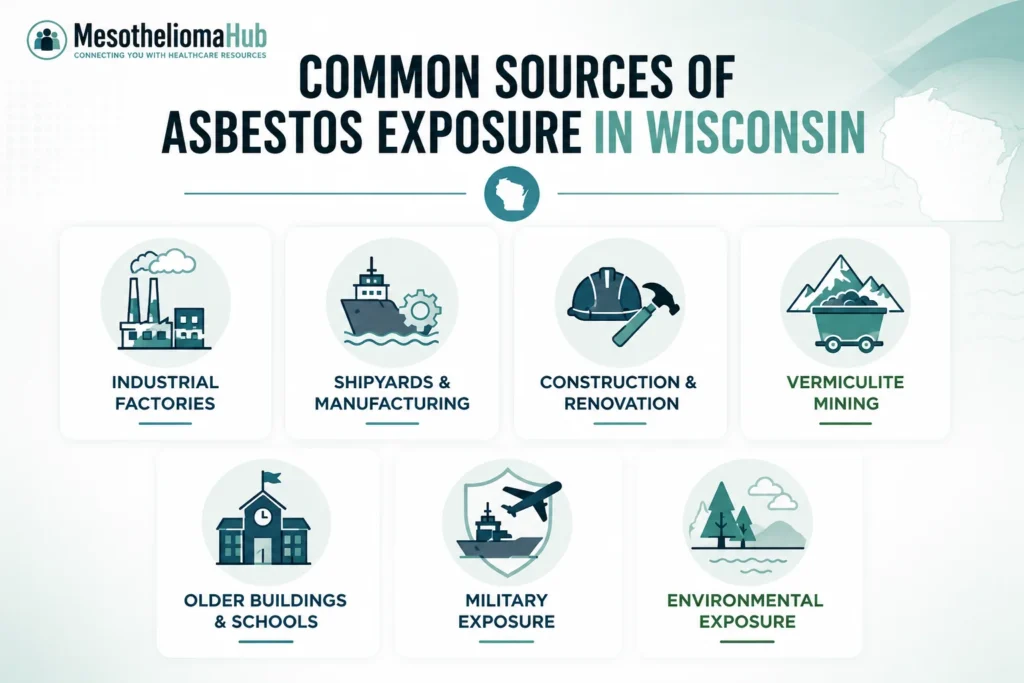
If you worked in one of these industries, asbestos exposure may have been part of your daily environment without you ever realizing it. Many mesothelioma patients in Wisconsin now trace their illness back to asbestos company operations that continued using asbestos products despite growing concerns about lung cancer and other asbestos-related diseases.
It may be surprising to hear that between 1999 and 2013, Wisconsin recorded more than 5,300 asbestos-related deaths.
Structures built before the 1970s are likely to have asbestos in some form. It can also be found naturally in the environment, in rock and mineral deposits. High-risk asbestos exposure locations in Wisconsin extend beyond residential and commercial buildings. Industrial sites in Milwaukee County, manufacturing plants in Waukesha County, and facilities in Wisconsin Rapids were also significant sources of occupational asbestos exposure for decades. Workers at these sites regularly handled asbestos products, including pipe insulation, boiler packing, and gasket materials manufactured by asbestos companies operating across the United States.
High-risk areas in buildings that can contain asbestos include:
Construction, demolition, and renovation jobs are at high risk for exposure. This is because the mineral is at its most dangerous when disturbed. During renovation and construction projects, harmful asbestos fibers can be expelled into the air and potentially inhaled or ingested. High-risk areas in Wisconsin include industrial areas in Milwaukee, Green Bay, and Racine.
Workers in Milwaukee County shipyards, Waukesha County manufacturing plants, and industrial facilities near Wisconsin Rapids experienced some of the highest rates of occupational asbestos exposure in the state. Many workers in these industries later developed mesothelioma, lung cancer, or another asbestos-related disease after years of working around asbestos-containing materials. In some cases, these diagnoses may qualify for compensation through a mesothelioma lawsuit or asbestos lawsuit.

Vermiculite is a naturally occurring, popular building material similar to asbestos. A mine in Libby, Montana, distributed a lot of vermiculite ore contaminated with asbestos to processing plants all over the U.S. Much of the Libby vermiculite was utilized in attic insulation and sold as Zonolite. Over 70% of vermiculite ore mined worldwide came from Libby.
Besides receiving contaminated vermiculite from Libby, Penokee Hills in Wisconsin also mined for iron ore contaminated with asbestos. To top that off, the Lake Superior Region supplies nearly three-quarters of the nation’s iron ore, primarily used for making steel.
Workers and residents near these mining and processing operations represent a significant number of asbestos exposure cases in Wisconsin. In many situations, pleural mesothelioma, lung cancer, and other asbestos cancer conditions developed years or even decades after the original asbestos exposure occurred.

W.R. Grace, a large chemical plant in Milwaukee, gathered and utilized the contaminated vermiculite, even after knowing of the danger. Genoa Power Plant is also guilty of exposing its workers to asbestos in the past. Some other places in Wisconsin with public exposure include the Monroe Clinic in Madison, which exposed employees to asbestos from 2008 to 2017. Grede Foundry in Berlin was also linked to asbestos exposure, but it closed the iron foundry down in 2015.
Employees at these Wisconsin facilities—and in some cases their family members through secondary asbestos exposure—may have grounds for a mesothelioma claim or asbestos case against the asbestos company responsible. An experienced Wisconsin mesothelioma lawyer can investigate employment records connected to these sites and determine whether asbestos trust funds or a mesothelioma lawsuit may apply.

The Environmental Protection Agency (EPA) has been working towards banning the use of asbestos for years. To help enforce regulations surrounding the cleanup and disposal of asbestos, the Comprehensive Environmental Response, Compensation, and Liability Act (CERCLA) was passed in 1986.
Also known as Superfund, CERCLA was created to hold organizations responsible for cleaning up hazardous and toxic contamination at industrial and commercial sites. If the company or parties responsible fail to take action, the EPA can step in and use federal Superfund resources to begin the cleanup process itself.
For many Wisconsin residents, these contaminated sites represent more than environmental concerns. They may also raise difficult questions about past asbestos exposure, particularly for people who worked near industrial properties, attended affected schools, or lived in surrounding communities for long periods of time.
The EPA maintains a comprehensive list of Superfund sites across the United States. Wisconsin sites include:

Building structures developed before the 1970s have a high probability of containing asbestos. This makes older homes, school buildings, and other residential properties a high-risk factor if any renovation, demolition, or construction takes place.
Besides the known school superfund sites listed above, a different Wisconsin school discovered asbestos inside its building as well. The school was Yorkville Elementary, located in Racine County. Later in the investigation, however, an outside firm stated that the asbestos tiles found in the elementary school were “low-risk.” If you have any concerns about asbestos in your child’s school, call them and inquire more; they must give you the information.

The U.S. military was once a large user of asbestos products in the building of military barracks, structures, military vehicles, Navy ships, shipyards, aircraft, and more. Truax Air Force Base in Madison had pipes and other items contaminated with asbestos. Since then, they’ve hired asbestos abatement (removal) services to extract the carcinogen.
If you served in the military and were exposed to asbestos during your service, you may still be dealing with the effects decades later. Wisconsin veterans who later developed mesothelioma, lung cancer, or peritoneal mesothelioma may be eligible for VA disability benefits alongside a mesothelioma lawsuit or asbestos trust funds claim. Many Wisconsin mesothelioma attorneys help veterans pursue both types of compensation at the same time.
A couple of scientists discovered over 100 pounds of asbestiform grunerite (brown asbestos-containing rock) in an old test pit in eastern Ashland County. In the 1970s, Reserve Mining in Minnesota dumped taconite tailings that contained asbestiform particles into Lake Superior, one of the costliest environmental cleanups in U.S. history. The spill was so massive that asbestos fibers were found in the drinking water from Lake Superior as close as Duluth, Wisconsin.
Over the years, both federal and state governments have introduced regulations designed to reduce asbestos exposure and improve safety standards in workplaces, public buildings, and construction projects. These laws also help hold companies accountable for the proper handling, removal, and disposal of asbestos-containing materials.
The Clean Air Act of 1970 helped establish some of the first major federal regulations surrounding asbestos exposure and environmental safety. Over time, additional restrictions were introduced to limit the use of asbestos in insulation, spray-applied materials, and other commercial products linked to serious health risks.
In 2018, the Environmental Protection Agency (EPA) strengthened oversight through updates to the National Emission Standards for Hazardous Air Pollutants (NESHAP). These regulations created stricter standards for asbestos inspections, demolition procedures, renovation projects, emissions control, and waste disposal.
Together, these federal regulations form part of the broader accountability framework designed to reduce asbestos exposure risks and protect workers, residents, and surrounding communities across the United States.
Each state has regulations about asbestos and how it should be handled and disposed of. Laws in Wisconsin include:
If the owner or operator of a contaminated structure fails to follow these regulations, they may be fined anywhere from $500 to $5,000 per violation per day.
These regulations are overseen by the Wisconsin Department of Natural Resources (DNR), which manages asbestos abatement notifications, contractor licensing, and compliance requirements across the state. Wisconsin asbestos law also works alongside federal EPA NESHAP standards, meaning violations by an asbestos company may lead to both regulatory penalties and civil legal action. In some situations, affected workers or Wisconsin residents may also have grounds to pursue an asbestos case or mesothelioma claim connected to unsafe asbestos exposure.
A patient diagnosed with mesothelioma or other asbestos-related conditions could be entitled to compensation from the asbestos companies responsible for the exposure. If you decide to take action against these companies, you only have a small window of time to do so. This is called the statute of limitations. In Wisconsin, the statute of limitations for filing a mesothelioma claim is three years after the initial diagnosis.
The person diagnosed has multiple options for filing. Firstly, they could file a personal injury claim, or if the person is already deceased, their family can file a wrongful death suit. Contacting an experienced attorney would prove extremely helpful, as they can efficiently navigate the complexities of your case and help you pursue the compensation available to you.
Wisconsin residents may also have legal options beyond a standard personal injury claim. A Wisconsin mesothelioma attorney can often pursue a mesothelioma lawsuit against active asbestos companies while also filing asbestos trust fund claims connected to bankrupt manufacturers. If military service played a role in the asbestos exposure, veterans’ benefits may also be available at the same time. Whether you have been diagnosed with pleural mesothelioma, peritoneal mesothelioma, or lung cancer linked to asbestos exposure, speaking with a Wisconsin mesothelioma lawyer sooner rather than later can help protect your legal rights. Many asbestos exposure cases across the state have already helped establish strong precedent for mesothelioma settlement outcomes.
For many Wisconsin residents, a mesothelioma diagnosis raises immediate questions about treatment, financial stability, and how asbestos exposure happened in the first place. Wisconsin mesothelioma attorneys help individuals and families understand their legal rights and pursue compensation connected to occupational, environmental, or secondary asbestos exposure.
An experienced Wisconsin mesothelioma lawyer can investigate where exposure occurred, identify the asbestos company or companies responsible, and help build a case connected to job sites, military service, industrial facilities, or asbestos-containing products used throughout the state. For mesothelioma patients already dealing with treatment and medical appointments, having legal support can also help reduce some of the pressure surrounding paperwork, deadlines, and insurance or financial concerns.

A mesothelioma lawsuit in Wisconsin allows a mesothelioma patient to pursue compensation from the asbestos company responsible for their asbestos exposure. These claims often involve manufacturers of asbestos products used at Wisconsin industrial sites, shipyards, paper mills, foundries, and power plants.
Wisconsin mesothelioma lawyers investigate employment records, union histories, military service documents, and asbestos company defendant records to help establish where exposure occurred and who may be legally responsible. If you worked in Milwaukee County shipyards, Waukesha County manufacturing facilities, or industrial sites near Wisconsin Rapids, these records may play an important role in your mesothelioma case.
While every case is different, mesothelioma settlement amounts can range from substantial six-figure recoveries to multimillion-dollar awards depending on exposure history, medical diagnosis, and the companies involved. Some mesothelioma victims who take their case to trial may receive higher compensation through jury verdicts.
In Wisconsin, a personal injury claim generally must be filed within three years of diagnosis, making it one of the state’s most important statute of limitations deadlines.
If a mesothelioma victim has already passed away, surviving family members may be able to file a wrongful death claim. In Wisconsin, these claims are generally required to be filed within three years of the date of death.
Wrongful death claims may help families recover compensation connected to medical expenses, funeral costs, lost income, and loss of companionship. For many families, this financial support can help ease some of the burdens created by a long-term asbestos-related illness.
Many asbestos companies that operated throughout the United States later filed for bankruptcy protection and established asbestos trust funds to compensate future asbestos victims. Today, billions of dollars remain available through active trust funds.
A Wisconsin mesothelioma attorney may file asbestos trust fund claims alongside a mesothelioma lawsuit, helping maximize the compensation available to mesothelioma patients and their families. In most situations, asbestos victims do not need to appear in court for trust fund claims, as the law firm handles the filing process and supporting documentation directly.
When choosing legal representation, it can help to prepare a list of questions to ask a mesothelioma lawyer and look for Wisconsin mesothelioma attorneys with direct experience handling asbestos litigation rather than general personal injury cases. Mesothelioma cases often involve decades-old exposure histories, multiple asbestos companies, and highly specialized medical and occupational evidence.
Some mesothelioma law firms have dedicated managing attorneys who oversee each mesothelioma case personally, helping ensure clients receive direct support throughout the legal process. Peer recognition, such as Super Lawyer or Best Lawyer designations, may also reflect experience in asbestos law and mesothelioma litigation.
Top law firms serving Wisconsin, including Milwaukee mesothelioma lawyers and Milwaukee mesothelioma attorneys, often travel directly to clients in Milwaukee County, Waukesha County, Wisconsin Rapids, and surrounding communities. This allows mesothelioma patients to focus on treatment and family responsibilities without needing to travel to a law office.
Many Wisconsin mesothelioma attorneys also handle related asbestos case types involving lung cancer, secondary asbestos exposure, and delayed diagnosis concerns. In some situations, a mesothelioma center referral may also be provided alongside legal representation, helping connect patients with specialized treatment options while their case moves forward.
Having a medical professional who has treated other cancer patients can be very helpful since asbestos-related conditions can sometimes look like other illnesses. Your doctor will also have good information on treatment, life expectancy, and more from similar patients they may have had.
Mesothelioma patients in Wisconsin also benefit from being close to several leading mesothelioma centers throughout the Midwest. Finding a mesothelioma center with experience treating asbestos-related diseases can be an important step alongside pursuing legal compensation. Specialized mesothelioma treatment may include surgery, chemotherapy, immunotherapy, and access to clinical trials that are not always available through general oncology programs. In some cases, a Wisconsin mesothelioma attorney or law firm may also help connect patients with mesothelioma center referrals while their legal case is ongoing.
Here are cancer treatment centers in or near Wisconsin:
Asbestos can be found all around the world and is best avoided if it’s in a disturbed state. We have a lot of helpful resources on asbestos exposure, mesothelioma, treatment, and more in our free guide. Download it in seconds to learn more about it.
If you are one of the many Wisconsin residents diagnosed with mesothelioma, lung cancer, or another asbestos-related disease, it can help to take action early. Connecting with a specialized mesothelioma center may help you better understand your treatment options, while speaking with a Wisconsin mesothelioma lawyer can help you explore available mesothelioma claim and asbestos lawsuit options before Wisconsin’s statute of limitations expires.
What is the statute of limitations for a mesothelioma lawsuit in Wisconsin?
Wisconsin allows mesothelioma lawsuits and personal injury claims to be filed within three years of a mesothelioma diagnosis. Wrongful death claims must generally be filed within three years of the date of death. Because these deadlines can directly affect your ability to recover compensation, speaking with a Wisconsin mesothelioma attorney as early as possible can be important. An attorney can review the details of your mesothelioma case and confirm which filing deadlines apply to you.
Do I need a Wisconsin-based mesothelioma lawyer, or can a national law firm handle my case?
Both options can be effective depending on your situation. Wisconsin mesothelioma attorneys with knowledge of local asbestos exposure sites — including Milwaukee County shipyards, Waukesha County factories, and Wisconsin Rapids industrial facilities — may offer valuable insight into regional asbestos exposure cases. At the same time, many national mesothelioma law firms also represent Wisconsin residents and travel directly to clients while bringing extensive asbestos litigation resources and nationwide asbestos company databases.
Can I file a mesothelioma claim if the responsible company no longer exists?
Yes. Many asbestos companies that operated throughout Wisconsin later established asbestos trust funds through bankruptcy proceedings. A Wisconsin mesothelioma lawyer may be able to file trust fund claims while also pursuing a mesothelioma lawsuit against any remaining solvent defendants. This approach may help maximize compensation for mesothelioma patients and their families.
What types of mesothelioma qualify for legal claims in Wisconsin?
Different asbestos-related diagnoses may qualify for compensation. This can include pleural mesothelioma, peritoneal mesothelioma, lung cancer caused by asbestos exposure, and other qualifying asbestos-related diseases. A mesothelioma attorney can evaluate your medical history, asbestos exposure background, and potential legal options based on the specifics of your case.
Wisconsin’s three-year statute of limitations means asbestos victims and mesothelioma patients should act promptly after diagnosis to better understand their legal options. Whether you are located in Milwaukee County, Waukesha County, Wisconsin Rapids, or elsewhere in the state, a Wisconsin mesothelioma attorney may be able to review your mesothelioma case at no upfront cost. Connecting with an experienced legal team can help you understand available mesothelioma claims and asbestos lawsuit options while helping preserve your legal rights moving forward.
Jennifer Verta thrives as a digital content writer at Mesothelioma Hub. She has been producing content for clients since before she graduated from the University of Colorado at Denver with a Bachelor of Arts in Communication and a Minor in English Writing. Jen’s mission is to help promote awareness of mesothelioma to as many people as possible by providing only the most up-to-date and accurate content available. When she isn’t cranking the gears at work, Jen can be found snowboarding, hiking, catching live music, or socializing with friends.
Asbestos Nation. (2019). Asbestos-Related Deaths in Wisconsin. Retrieved on December 17, 2019, from https://asbestosnation.org/facts/asbestos-deaths/wi/
The Cap Times. (2013) Asbestos in Rocks Won’t Stop Northern Wisconsin Mine, GTac Maintains. Retrieved on December 17, 2019, from https://madison.com/ct/news/local/writers/mike_ivey/asbestos-in-rocks-won-t-stop-northern-wisconsin-mine-gtac/article_81390910-3693-11e3-a54c-001a4bcf887a.html
Congress. (2004). S. Rept. 108-309 – MILITARY CONSTRUCTION APPROPRIATION BILL, 2005. Retrieved on December 17, 2019, from https://epa.gov/asbestos/asbestos-laws-and-regulations
EPA. (2019). Superfund Site Search Results. Wisconsin. Retrieved on December 17, 2019, from https://cumulis.epa.gov/supercpad/CurSites/srchsites.cfm
EWG. (2004). Asbestos: Think Again: Deaths Due to Asbestos Related Diseases by State. Retrieved on December 17, 2019, from https://ewg.org/research/maps/deaths-due-asbestos-related-diseases
FindLaw. (2019). Wisconsin Asbestos Regulations. Retrieved on December 17, 2019, from https://statelaws.findlaw.com/wisconsin-law/wisconsin-asbestos-regulations.html
Madison Asbestos. (2019). Digging Up Asbestos in Wisconsin. Retrieved on December 17, 2019, from https://madisonasbestos.com/digging-up-asbestos-in-wisconsin/
National Cancer Institute. Asbestos. (2019). Finding a Cancer Center. Retrieved on December 16, 2019, from https://cancer.gov/research/nci-role/cancer-centers/find
Racine Home Insulators, LLC. (2019). Vermiculite Removal in Racine, Kenosha and Milwaukee County. Retrieved on December 17, 2019, from https://racinehomeinsulators.com/vermiculite-removal-in-racine-kenosha-and-milwaukee-county
Roesler, J. (2016). 2016 Annual Report. Retrieved on December 17, 2019, from https://nrc.gov/docs/ML1911/ML19114A103.pdf
Schuman, D. (2019). Letter Warns Parents of Potential Asbestos Exposure at Yorkville Elementary. Retrieved on December 17, 2019, from https://cbs58.com/news/letter-warns-yorkville-elementary-staff-parents-of-potential-asbestos-exposure
Wicourts. (1996). Published Opinion. W.R. Grace & Company. Retrieved on December 17, 2019, from https://wicourts.gov/ca/errata/DisplayDocument.html?content=html&seqNo=8989
Wisconsin Department of Natural Resources. (2019) Asbestos Removal and Notification. Retrieved on December 17, 2019, from https://dnr.wi.gov/topic/Demo/Asbestos.html